America 250 Activity for Teaching the Children Our National History
by Nicholeen Peck
Years ago, a professor told me that only 4% of the population of the United States of America has actually read the entire Declaration of Independence. My heart sank. That number was far too low.
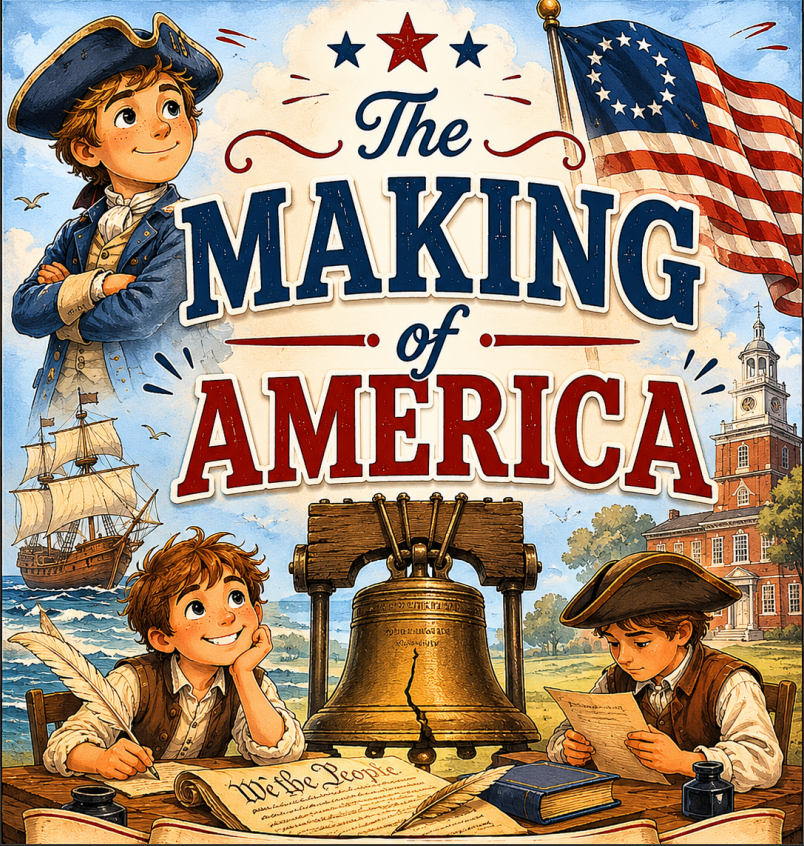
Since this year marks the 250th anniversary of the Declaration of Independence, it’s the perfect time to boost that percentage. If you’re like me, then when you’re teaching something, that’s when you really get serious about learning it yourself. The images in this article will help you learn alongside your child about the founding of the United States of America in a fun and engaging way that our family calls a lapbook.
Group Learning
I lead a group of boys ages 9–11 at my church. With America 250 happening and all the faith leaders around the world chiming in on the importance of celebrating the founding of the United States as well as protecting religious liberties, my husband (my valiant co-leader) and I felt that we should focus on teaching the boys about our covenant land and the founding of the United States of America.
We held two meetings. The first meeting was dedicated to building a Making of America lapbook. (Print-ables are below in the PDF section. Have the pieces pre-cut if possible. Assemble the lapbooks using file folders and packaging tape for the best results. See the video above.) The second meeting featured a Jeopardy game with questions taken from the lapbook study guide. The boys were allowed to keep their lapbooks with them so they could research the answers. (Game document link is also below.)
Honestly, I wish we would have had more time as we put the books together. If I had been making the lapbook with my own children, as we often did when they were young, I would have spent a portion of a day on each section, or even on each person and event. The way the book is organized, you can use it as a launching point for a deep and meaningful summer study, or you can simply use it as a fun summary of the founding era and its principles. Either way, it is a treasure. If you want to discuss items while assembling them, then I would recommend at least a 1.5 hour session. Of course, you could always assemble, have them study on their own, and then use the books while playing the Jeopardy game the next time you meet.
Home and Family
If you’d like to take a slower approach to learning with your children at home, or even to complete the project yourself, I recommend beginning this week of July 4th and continuing through the summer or the remainder of the year.
Start with the timeline page and briefly discuss the series of events leading up to becoming an independent nations. After that foundation is laid, talk about the people one by one, finding and sharing additional stories about them while also learning the vocabulary words. This is a great way to prepare for studying the founding documents.
After that study is complete, study the spiritual components to the the lapbook and discusss how we can strengthen our spirituality and characters to help preserve our nation.
Don’t forget to learn how to fold and cut Betsy Ross stars with one cut. It’s a fun skill to learn, and children really enjoy it. (Video link below.)
Since we were preparing the lapbooks for a large group, we kept them fairly simple. However, doing the project as a family opens the door to being as creative as you’d like. Maybe your child could write narrations about favorite events or historical figures or draw pictures and attach them to the lapbook as well. Make it your own.
The Organization
The lapbook study guide and the Jeopardy game were divided into the following five categories.
1. The People
People like George Washington, Betsy Ross, Molly Pitcher, Abigail Adams, John Adams, Patrick Henry, and Paul Revere played crucial roles in the founding of the United States of America. As children study their stories and character traits, these real heroes from our past can instruct and inspire the next generation to live by principle and make a positive difference in the world. The founding mothers and fathers of our country demonstrated the true American dream: hard work, strong character, grit, integrity, and wisdom enable people to live their purpose and accomplish their dreams.
2. The Words
Words such as Continental Congress, patriot, tyranny, Sons of Liberty, Rule of Law, Magna Carta, Mayflower Compact, self-evident, pluralism, and judiciary are vital terms for understanding the national, covenant history of our nation and the principles we must know in order to preserve our covenant land.
3. The Events
The timeline page begins with the Jamestown settlement and ends with George Washington becoming our first president. It shows how much time passed between the arrival of the early settlers and America’s becoming an independent nation. It also demonstrates how much sacrifice, through both battles and careful debate over important documents, was required to establish the free society we know and love today—and too often take for granted.
4. The Documents
The documents section is where you really get to explore the great debate that led to the formation of the United States by studying Patrick Henry’s speech and Thomas Paine’s Common Sense. The great freedom debate of the 1700s ultimately produced the now 250-year-old Declaration of Independence. The shortened version included here contains the document’s most recognizable language while leaving out the grievances against the king. Even so, be sure to read the entire Declaration at least once during your study. (We need to increase that percentage of citizens who have read it in full.) The Constitution, also abbreviated here, is divided into four pages to make discussing its components easier and to help illustrate the amendments.
5. The Spiritual Sections
The spiritual section may not seem like a usual part of the study of our founding, but depending upon God is a vital part of the founding story. Teaching children about covenants, about the long history of covenant-making prayers in this land, and about the Founders’ day of fasting and prayer as they prepared to take their courageous stand for independence helps children recognize that God’s hand has always been part of the story of freedom in this land. The story of George Washington’s inauguration prayer at St. Paul’s Church touches my heart every time I hear it. It is a sign of true humility and devotion. No wonder that Washington was loved by the people so deeply. He is one of my heroes, like he has been for countless American’s throughout our 250 year history.
Live as a Witness of God’s Hand in Our Country and Our Lives
I’m in the House of Representatives in my state. I learned pretty quickly that there’s no way to please everyone and that if I served with wisdom, I would inevitably disappoint some people.
You see, the service an elected official renders should never be about that individual or even about one particular issue. It should be about protecting the process and the principles of freedom so that wisdom can prevail.
This means every proposed program, agency, entity, or idea must always be measured against the true principles that established our system and are part of our ongoing covenant to follow Him as we partake of this covenant land.
As you look through these PDFs, and perhaps print them to use with your family, take a moment to appreciate God’s hand in all the details surrounding the founding of this country 250 years ago. He is the author and finisher of all good things, including the founding of the United States.
Can we keep it? Only if we take the time to understand that our national identity is part of our personal identity.
Teach the children.
Now, perhaps more than ever, we need to remember who we are and turn our hearts to God.
The PDFs
Making of America Lapbook (Main Text)
The Declaration of Independence
The Preamble to the Constitution
The Articles of the Constitution
Washington’s Prayer and Day of Fasting
The Jeopardy Questions and Answers
The video about how to cut a Betsy Ross star with one cut
Have you downloaded the Teaching Self-Government App yet? It’s free and has other TSG free resources to help your family feel more united.